Best Roofing Materials for Texas Climate: 2026 Complete Guide
Compare the best roofing materials for Texas heat, hail, and storms. See how metal, impact-rated shingles, and clay tiles stack up for lifespan, cost, and warranty.
Texas throws everything at your roof: triple-digit heat, baseball-sized hail, hurricane-force winds, and UV radiation that never quits. Choosing the wrong material means premature failure, costly repairs, and insurance headaches. Choosing right means decades of protection and lower long-term costs.
This guide breaks down what actually works in Texas--not marketing claims, but real performance data from roofs we've installed across the state.
What Makes Texas Roofing Different
Texas isn't just hot. It's a combination of extremes that stress roofing materials in ways most products aren't designed to handle.
The Heat Factor
Austin, Houston, Dallas, and San Antonio all experience 100+ degree days regularly from May through September. But air temperature only tells part of the story. Roof surface temperatures can reach 160-180 degrees Fahrenheit on dark-colored roofs. That kind of heat accelerates aging on every roofing material--shingles crack, metal expands and contracts, and underlayments break down faster.
Hail Alley Reality
Texas sits squarely in Hail Alley. According to NOAA data, the Dallas-Fort Worth metroplex experiences more damaging hail events than anywhere else in the country. Austin and San Antonio aren't far behind. In 2024 alone, Texas insurers paid out over $12 billion in hail claims. Your roof isn't just shelter--it's your first line of defense against these annual assaults.
Wind and Storm Exposure
Houston and the Gulf Coast face hurricane threats. North Texas deals with severe thunderstorm downbursts exceeding 80 mph. Even Central Texas experiences straight-line winds that tear off poorly fastened shingles. Wind resistance isn't optional in any part of the state.
Heat Resistance: Keeping Your Home Cool
A roof's ability to manage heat directly impacts your cooling costs and material longevity. Here's how different materials perform:
Cool Roof Ratings Explained
The two metrics that matter are Solar Reflectance (SR) and Thermal Emittance (TE). Solar reflectance measures how much sunlight bounces off your roof instead of being absorbed. Thermal emittance measures how well your roof releases absorbed heat. Higher numbers mean better performance.
| Material | Solar Reflectance | Thermal Emittance | Cooling Savings |
|---|---|---|---|
| Light Metal (White/Silver) | 0.60-0.70 | 0.85-0.90 | 20-25% |
| Clay/Concrete Tile | 0.30-0.50 | 0.85-0.90 | 15-20% |
| Cool Roof Shingles | 0.25-0.40 | 0.80-0.90 | 10-15% |
| Standard Dark Shingles | 0.05-0.15 | 0.85-0.90 | 0% |
For Texas homes with adequate attic insulation, a light-colored metal roof can reduce peak cooling demand by 10-15%. That translates to $200-$400 per year in electricity savings for average homes--compounding over the roof's 40-70 year lifespan.
Hail Resistance: Understanding Impact Ratings
Impact resistance is measured by UL 2218 classifications. Class 4 is the highest rating, indicating the material can withstand 2-inch steel ball impacts without cracking or splitting.
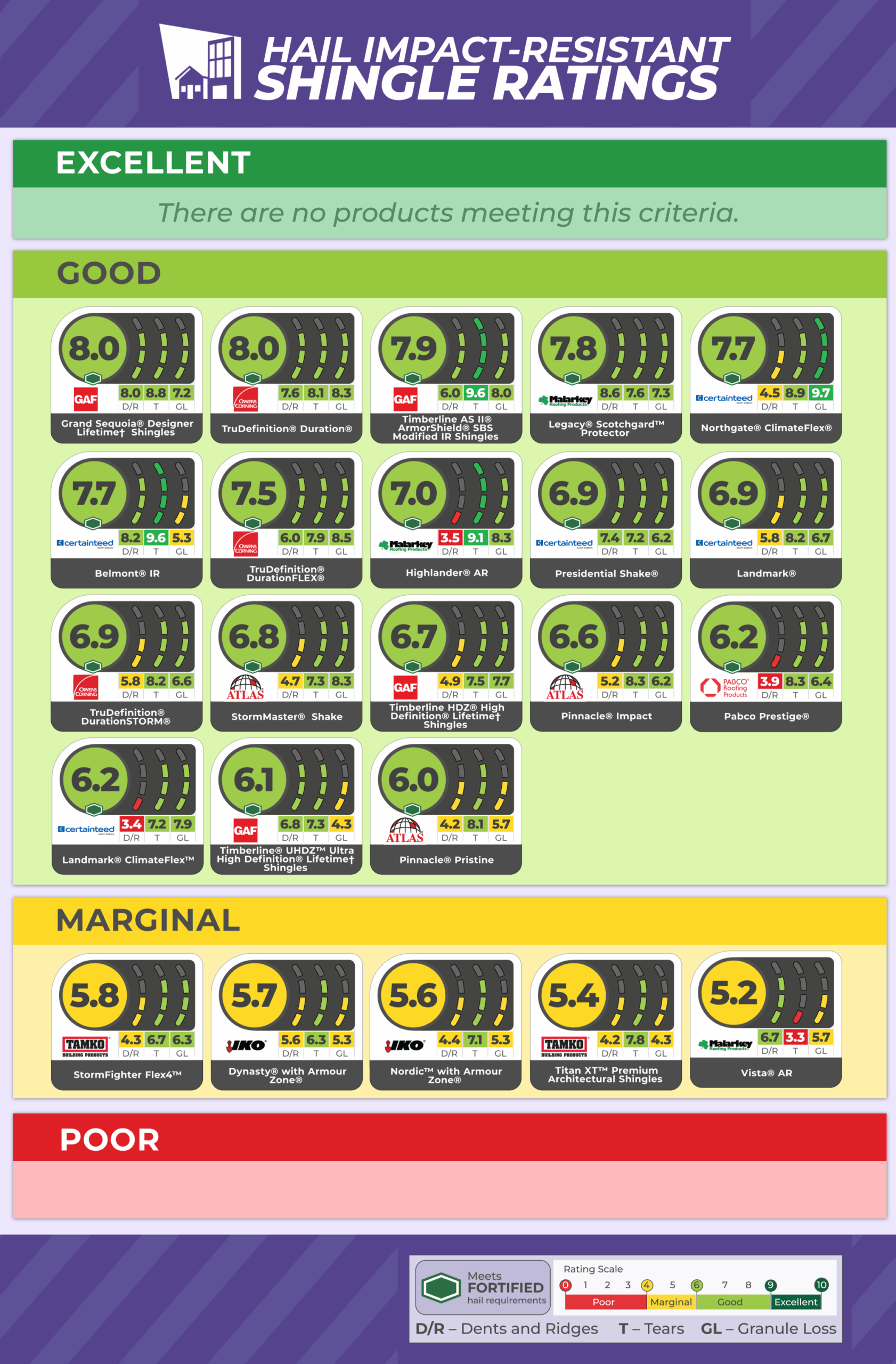
But here's what most Texas homeowners don't realize: UL 2218 testing uses steel balls, not ice. Real hail behaves differently. The Insurance Institute for Business & Home Safety (IBHS) now tests with lab-made ice hailstones that better simulate actual storm conditions. Their testing reveals significant performance gaps between products that all carry the same Class 4 rating.
Class 4 Isn't Enough Information
A Class 4 rating tells you a product passed minimum testing--not how well it performs in real conditions. IBHS scores range from 0-10, with 6+ rated "Good." In their 2025 testing:
- Top performers scored 7.8-8.0 (Owens Corning Duration, GAF Grand Sequoia)
- Mid-pack products scored 6.5-7.5
- Some Class 4 rated products scored as low as 5.2-5.8 ("Marginal")
See the complete IBHS shingle rankings for Texas -->
Impact-Rated Shingles: The Sweet Spot for Most Texas Homes
For the majority of Texas homeowners, Class 4 impact-resistant asphalt shingles offer the best balance of protection, aesthetics, and value. But product selection matters significantly.
Top Performers for Texas
Owens Corning TruDefinition Duration scored 8.0 in IBHS testing--tied for first place. The SureNail technology provides excellent fastener strength, and the modified bitumen core flexes rather than cracks during hail impacts. This is our primary recommendation for hail-prone areas.
GAF Timberline AS II ArmorShield scored 7.9, with particularly strong performance in the Granule Loss category. The SBS-modified asphalt provides flexibility in extreme heat and cold cycles.
Malarkey Legacy scored 7.8 and uses rubberized polymers for impact absorption. Good option for homeowners wanting a non-mainstream brand with proven performance.
Insurance Benefits
Texas insurers typically offer 10-28% premium discounts for Class 4 roofs. For a homeowner paying $3,000 annually for coverage, that's $300-$840 per year in savings. Over a 25-year roof lifespan, that's $7,500-$21,000--often exceeding the premium you paid for impact-resistant materials.
Warranty Considerations
Standard architectural shingles carry 25-30 year warranties. Impact-resistant versions typically match or exceed this. However, warranty terms vary significantly:
- Owens Corning Duration: Lifetime limited warranty, 50 years on algae resistance
- GAF Timberline AS II: Lifetime limited warranty, unlimited wind speed coverage with proper installation
- CertainTeed Landmark Impact: Lifetime limited warranty, 15-year algae resistance
All major manufacturers require professional installation to activate full warranty coverage. As a GAF Master Elite contractor (top 2% nationwide), we offer GAF's Golden Pledge warranty with 25-year workmanship coverage.
Metal Roofing: Premium Protection for Texas Extremes
Metal roofing represents the premium tier for Texas homes. Higher upfront cost, but unmatched longevity and performance in our climate.
Standing Seam vs. Metal Shingles
Standing seam systems feature raised interlocking seams that provide superior wind and water resistance. They're the gold standard for metal roofing--and priced accordingly at $10-$15 per square foot installed. Hidden fasteners mean no penetrations that can leak or corrode.
Metal shingles and panels cost less ($6-$10 per square foot) but use exposed fasteners that may require maintenance over time. They offer good performance but lack the ultimate durability of standing seam.
Performance Advantages
| Factor | Metal Roofing | Asphalt Shingles |
|---|---|---|
| Lifespan | 40-70 years | 20-30 years |
| Wind Resistance | 140+ mph | 110-130 mph |
| Heat Reflection | 60-70% (light colors) | 5-40% |
| Hail Resistance | Dents but doesn't fail | Cracks and loses granules |
| Maintenance | Minimal | Periodic inspections |
The hail caveat: Metal roofs dent during major hail events but maintain their weather barrier function. Unlike shingles that crack and lose protective granules, dented metal continues protecting your home. However, cosmetic damage may still trigger insurance claims, and some insurers are adjusting policies to exclude "cosmetic only" metal roof damage.
Cost Analysis
Metal roofing costs 2-3x more than asphalt shingles upfront. For a 2,000 square foot roof:
- Asphalt shingles: $10,000-$16,000 installed
- Standing seam metal: $20,000-$32,000 installed
But when you factor in lifespan, the math changes. An asphalt roof lasting 25 years means 2-3 replacements over 60 years (approximately $30,000-$48,000 total). A metal roof lasting 60 years is a one-time investment. Add energy savings of $200-$400 per year, and metal often costs less over the ownership period.
Clay and Concrete Tiles: The Heritage Option
Clay and concrete tiles dominate Mediterranean, Spanish, and Mission-style architecture throughout Texas. Beyond aesthetics, they offer genuine performance benefits.
Performance Profile
Heat management: Tile roofs create a natural air gap that provides additional insulation and ventilation. Combined with thermal mass that delays heat transfer, tiles keep homes cooler during peak afternoon temperatures.
Longevity: Quality clay tiles last 75-100+ years--longer than any other residential roofing material. Concrete tiles last 40-50 years. Either outlasts the typical mortgage.
Hail and wind: Modern installation methods with foam-set adhesive and metal clips dramatically improve wind resistance. However, tiles can crack from large hail impacts and are more expensive to repair than shingles.
Structural Considerations
Tile roofs weigh 8-12 pounds per square foot--3-4x heavier than asphalt shingles. Many Texas homes, especially those built before 2000, weren't designed for this load. Retrofitting requires structural engineering assessment and potentially reinforcement, adding $5,000-$15,000 to project costs.
Cost Profile
| Tile Type | Cost per Sq Ft | 2,000 Sq Ft Home | Lifespan |
|---|---|---|---|
| Concrete Tile | $10-$15 | $20,000-$30,000 | 40-50 years |
| Clay Tile | $15-$25 | $30,000-$50,000 | 75-100+ years |
Complete Material Comparison
Here's how all options stack up across the factors that matter most in Texas:
| Material | Lifespan | Cost (2,000 sq ft) | Warranty | Best For |
|---|---|---|---|---|
| Class 4 Shingles | 20-30 years | $11,000-$18,000 | Lifetime limited | Hail-prone areas, budget-conscious |
| Standing Seam Metal | 40-70 years | $20,000-$32,000 | 40-50 years | Long-term value, energy savings |
| Concrete Tile | 40-50 years | $20,000-$30,000 | 50 years typical | Mediterranean style, durability |
| Clay Tile | 75-100+ years | $30,000-$50,000 | 75 years typical | Historic homes, forever roof |
Our Recommendation by Situation
Best overall value for most Texas homes: Class 4 impact-resistant shingles (Owens Corning Duration or GAF Timberline AS II). Strong IBHS scores, insurance discounts, and proven performance at a reasonable price point.
Best for long-term ownership: Standing seam metal roofing. If you plan to stay in your home 15+ years, the math favors metal over multiple shingle replacements.
Best for specific architectural styles: Clay or concrete tile for Spanish, Mediterranean, or Mission-style homes where appearance matters as much as function.
Our Experience in Texas
From our team: After years of installing roofs across Texas, the pattern is clear: product selection matters less than most homeowners think, and installation quality matters more. A mid-tier shingle installed correctly outperforms a premium product installed poorly. That said, for hail-prone areas like Austin and the DFW metroplex, we consistently recommend Owens Corning Duration or GAF Timberline AS II--both have proven themselves in our market with strong IBHS scores and reliable warranty support. For customers who can invest in metal, the 40-70 year lifespan and energy savings make it the most cost-effective choice over time, despite the higher upfront cost.
-- Hunter Lapeyre, Owner
Frequently Asked Questions
Light-colored metal roofing provides the best heat resistance, reflecting 60-70% of solar radiation and reducing cooling costs by 20-25%. Clay and concrete tiles also perform well due to their thermal mass and natural ventilation. Cool roof shingles with reflective granules offer moderate improvement over standard dark shingles.
Yes. Texas sits in Hail Alley, experiencing more damaging hail events than any other state. Class 4 shingles provide documented protection and typically qualify for 10-28% insurance premium discounts. Over a 25-year roof lifespan, insurance savings often exceed the premium paid for impact-resistant materials.
Standing seam metal roofs last 40-70 years in Texas with proper installation. Even with our extreme heat, UV exposure, and occasional hail, quality metal roofing systems require minimal maintenance and maintain their weather barrier function throughout their lifespan.
Class 4 impact-resistant shingles with high IBHS scores (7.0+) provide the best value for hail protection. Top performers include Owens Corning Duration (8.0 score) and GAF Timberline AS II (7.9 score). Metal roofs dent but continue functioning, while tile roofs may crack from large hail.
For a 2,000 square foot roof: standard architectural shingles cost $10,000-$16,000, Class 4 impact-resistant shingles cost $11,000-$18,000, standing seam metal costs $20,000-$32,000, and clay tile costs $30,000-$50,000. Storm damage may be covered by insurance, reducing out-of-pocket costs significantly.
Modern metal roofing with proper underlayment and attic insulation is no louder than asphalt shingles during rain. The solid roof deck, synthetic underlayment, and attic space create sound dampening that eliminates the "tin roof" noise associated with old agricultural metal buildings.
Quality asphalt shingles carry lifetime limited warranties (typically 30-50 years of actual coverage). Standing seam metal warranties range from 40-50 years. Tile roofs often carry 50-75 year warranties. All major manufacturers require professional installation to activate full warranty coverage.
Many Texas homes require structural assessment before tile installation. Tile roofs weigh 8-12 pounds per square foot--3-4x heavier than asphalt shingles. Homes built before 2000 may need reinforcement, adding $5,000-$15,000 to project costs. A structural engineer can evaluate your specific situation.

Hunter Lapeyre
Owner, Lapeyre Roofing